Zernio: the platform approvals done once, sold to developers as an API
Zernio is a unified API for posting, messaging and ads on social networks, WhatsApp and ad platforms, for developers who build those features into their products. On the Itnig podcast, founder Miquel Palet told how he launched it in a weekend and took it to about €5M ARR in 13 months, with nine people and no investors.


- Question
- How does a developer API go from a weekend launch to €5M ARR in 13 months with nine people, and which parts of the map did it take?
- How I looked
- Itnig podcast episode, published on YouTube on 12 Nov 2026, 91 minutes, in Spanish, with Bernat Farrero asking. I did not talk to Miquel. I worked from YouTube's automatic Spanish transcript; the quotes are my translation. Every number is Miquel's, as he said it on the episode; I have not seen Zernio's accounts. Product facts and prices checked on zernio.com on 15 Nov 2026.
- Product
- Zernio by Miquel Palet. A unified API, MCP server and CLI for social media, ads, WhatsApp, SMS and email, with each platform's app review already done.
- Episode
- Itnig podcast hosted by Bernat Farrero · 12 Nov 2026 · 1 h 31 min · in Spanish
- Guest
- Miquel Palet, Founder of Zernio
Who and what
Miquel Palet, Miki on Zernio’s team page, left a computer engineering degree in Barcelona to help build Ucademy, then left Ucademy in 2024 to start again on his own. In August 2025 he launched a new product over a weekend. Thirteen months later it makes about €5 million a year in recurring revenue. He owns all of it and has not raised a euro.
Zernio is a unified API for social media, ads and messaging, for developers who want to offer those features inside their own product. With one integration, a product can publish, schedule, answer comments and DMs and read analytics on Instagram, TikTok, LinkedIn, X, YouTube, Facebook and ten more networks, run campaigns on nine ad networks, and send WhatsApp, SMS and email. It comes as a REST API with eight SDKs, an MCP server and a CLI. It used to be called Late.
What it sells is waiting time. Before your users can post to Instagram from your app, Meta has to approve your app. Zernio has done the approvals, and your users connect through its app instead.
I did not talk to Miquel. This piece comes from his conversation with Bernat Farrero on the Itnig podcast, out on 12 November. Like Mamitsu, the last product I profiled, Zernio is software for other software and for agents, but this one already has the numbers. I grouped it by territory and added what I would ask and test.
Zernio's home page: skip months of platform approvals
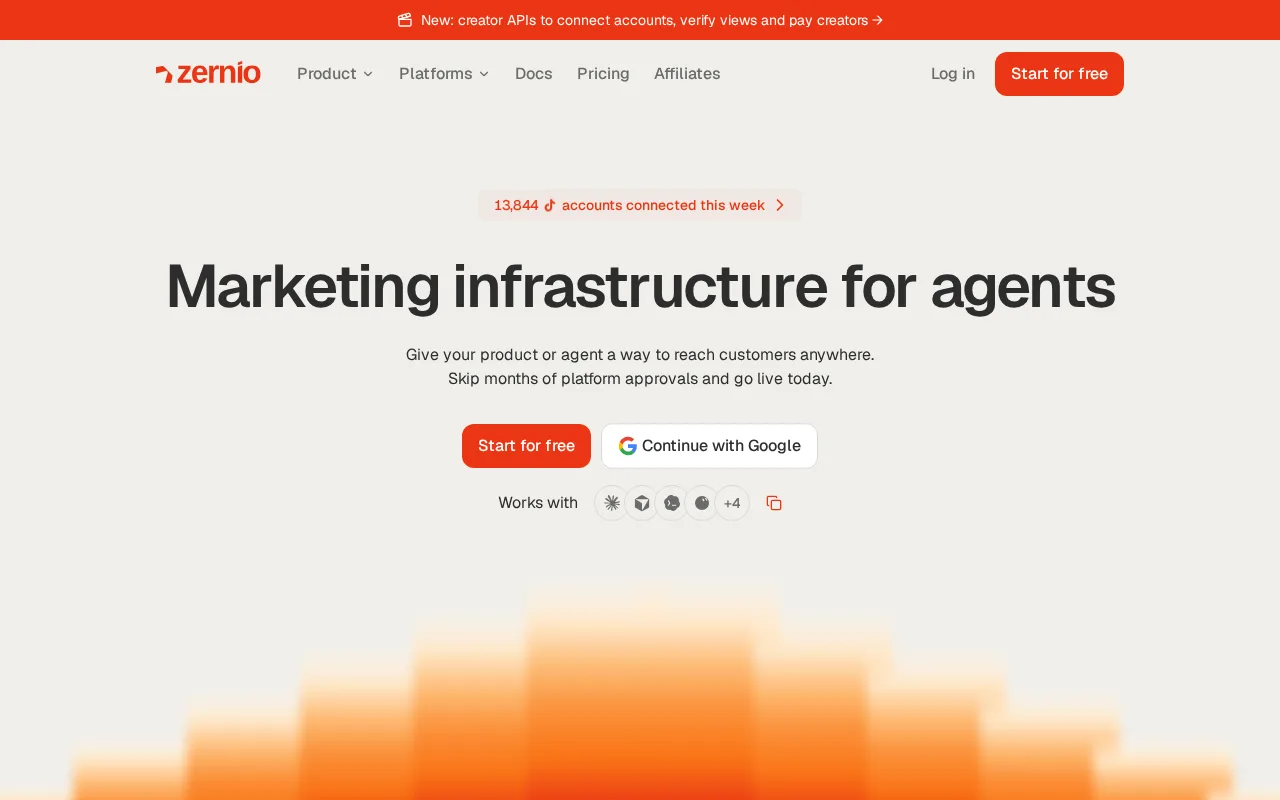
- 1The pitch is the waiting it saves, not the endpoints.
- 2ValueLive usage, straight from production, as the first thing on the page.
- 3Claude Code, Cursor, Codex and four more agents, before any code sample.
Zernio, 13 months after launch
- €5M
- ARR
- Almost there, from zero
- 9
- People
- Six developers, all remote in Spain
- €0
- Raised
- He owns 100%
- 10k
- Paying users
- Of about 200,000 accounts
A nine-person team with no investors, growing about €1M of ARR a month.
ReportedMiquel Palet on the Itnig podcast, 12 Nov 2026
On the map
The episode reached nine of the twelve territories of the Skills Map and 39 skills. Each icon takes you to its section. The quick tour goes through the 39 skills one at a time, with what each meant for Zernio.
Where the episode went
9 of 12 territories · 39 skills
Experience, Activation and Shipping did not come up. A business podcast leans to Strategy and Distribution: those two hold more than a third of the skills.
Discovery: a weekend bet on developers, not marketers
After Ucademy, Miquel spent a year he calls lost, with no cash, trying things. One, a tool that fetches supplier invoices, reached €7,000 to €8,000 MRR and later sold for about €200,000, but it was a crowded idea. On Twitter he saw lots of people building social media schedulers as side projects. His twist was to sell the plumbing to developers instead of the tool to marketers. No market study, a weekend of building and, compared with everything else he had launched, “people wanted it” from day one.
Our customers are not marketers. Our customer is a developer whose product team has said: let's build this integration.
The need is in the platforms’ rules. Bernat, who only uses X, pushed back: on X there is no approval to wait for. True, Miquel said, while the account is your own. The trouble starts when your users connect theirs to your product.
Letting your users post and run ads from your product
| Your own integration | Through Zernio | |
|---|---|---|
| Developer app | One per platform | Zernio's, already approved |
| Meta's app review | A screencast, then about 14 days | Done |
| A new permission, like ads | Another review | Already covered |
| YouTube upload quotaZernio waited six months for its own | Ask for an increase | Already raised |
| Expiring tokens | Yours to refresh | Refreshed for you |
| What your users seeWhite label: Zernio never shows | Your product | Your product |
Each line is a wait or a chore Zernio takes on once, for every customer.
ReportedMiquel Palet on the episode; white label and token refresh also on zernio.com, read 15 Nov 2026
Why not build it in-house? Time, and it is not their core. Zapier and n8n connect to the same platforms, but you still bring your own developer app. Metricool is the finished tool for a marketer: “we let other people build Metricool”. The direct rival was Ayrshare, which owned the search results and, as he tells it, moved slowly. And Twilio has sold the same model for WhatsApp for years.
Who pays, in his order: SaaS products that embed Zernio white-labelled, often AI apps that generate images and want to publish them; agencies with their own platform; and last, people managing their own accounts, often from Claude: most of the accounts, the least revenue.
Strategy: from lifetime deals to a price per account
The first revenue came from lifetime licences on AppSumo. “When you have no users, you prefer users who pay you once to no users who never pay you.” About 2,000 licences, a bit over $200,000 in sales, about $100,000 for him, paid 90 days later. It funded the first ads and the first hire.
How Zernio has charged, from launch to now
- Aug 2025Launch on AppSumoShippedAbout 2,000 lifetime licences.
- Aug 2025Subscriptions on the siteDecisionPlans by connected accounts: 50, 500 or unlimited.
- Feb 2026Pay per useDecisionAround then. Two accounts free with no card, then a fee per account, message and number.
- Aug 2026€3M ARR announcedResult"With a bit of delay", he said.
- Nov 2026Almost €5M ARRResultGrowing about €1M of ARR a month.
ReportedMiquel Palet on the episode; current prices on zernio.com/pricing, read 15 Nov 2026
Tiers meant add-ons and upgrade friction, but the main reason was another.
If we have a single plan and our customer gets to 50,000 users, we are not charging them any more. That makes no sense for us.
Now the price is per connected account: two free, then $6 a month each up to ten, $3 up to a hundred and $1 beyond, with messages, numbers and managed ads metered on top. Net MRR expansion, what existing customers add each month, is now Zernio’s main metric. New products bill themselves, without a new checkout. Gross margin is around 87%, “without having optimised anything”.
Bernat saw pressure from two sides: platforms that could cut Zernio out, and big customers that could build it in-house. The second has not happened that Miquel knows of. For the first, he stays compliant and tries to get as far up each platform as he can.
Zernio captures the cost of Meta's own inefficiency in approving apps. It is money Meta is leaving on the table.
Miquel’s answer is Twilio again: Meta lets it charge on top of WhatsApp’s fees. Whether Meta allows the same on Instagram, “Meta will decide”. The business sits in a grey zone the platforms tolerate today. And the moat is not the code: mapping endpoints is easy, he said himself.
What he will not build is a Metricool of his own: it would compete with his customers, with different churn and different sales. Instead, this year Zernio added ads, WhatsApp, phone numbers and commerce APIs, often after integrators asked. Ads are about 15% of accounts and get the most requests; few APIs cover them.
Engineering: the API is the product
“Most features we no longer build for the UI, only for the API.” The dashboard shows maybe half of it, mostly logs, keys and usage for debugging. The site states it as a rule: if it is not in the API, it does not ship.
One call from a customer's product, and the events that come back
The customer's code talks to one API; the approved apps in the middle are what it pays for.
Analytics too: Zernio stores and refreshes them, so one call returns a week across all of a user’s accounts.
The volume is real: about 100,000 posts a day and a constant stream of platform webhooks. Those events used to run on cron jobs, “not a good way to handle many events”, and were the first thing moved to Cloudflare queues.
AI: an MCP server that comes with the API
“The MCP is a wrapper of the API that we generate automatically when the API is generated.” So is the CLI. Agents get every endpoint at no extra cost: the site lists 496 MCP tools and 371 CLI commands. The API “has always been king”, and they do not track which interface people use. End users mostly come through MCP, checking their campaigns from Claude or Codex, and some customers sell marketing on autopilot built on Zernio.
Inside the team, agents do much of the work. Miquel had not coded at Ucademy, and Cursor arrived just as he needed to start again. He answered the launch’s support tickets with Claude, and Claude writes the migrations, with someone making sure nobody notices. Asked what money would do for the product, he said more people was not the answer.
We are trying to improve our processes so that we are not the meat proxy between Claude and our customers.
Operations: 300 tickets a day and the cloud bill
The AppSumo launch brought 300 support tickets a day. Who answered? “Me.” Three months in he hired Pau, a developer, and they took turns. The third hire, Elean, is a developer who only does support.
Zernio started on Vercel and is moving to Cloudflare because “Vercel at our scale is very expensive”. The queues went first; the whole API is next, with zero downtime and without a single user noticing. Free accounts stay cheap, with one exception: X’s API is paid, so connecting X asks for a card and Zernio passes the cost through.
Zernio also publishes its production numbers, failures included: “APIs break. Tokens expire. Platforms return 500s at 2am.”
The episode did not cover how nine people keep up with the changes of some 25 platforms. The site says those changes “are ours to absorb”. How, is the first thing I would ask him.
Distribution: AppSumo, Google and a name you can search for
Posting the launch on LinkedIn and the like did little: “nobody cares, your ideal customer is not there”. AppSumo brings the demand itself, writing to its own list. He launched there on 5 August 2025.
Then search. About 40% of new business comes from organic Google, on long-tail searches like “social media API” or “Meta app review”. Ayrshare owned those; Zernio now ranks above it on many. Landing pages and link building helped early; what worked best was users posting about Zernio and linking to it. A writer outside the team writes only blog posts, meant to be useful. They pay for spots in “best Meta API” rankings and built Zapier and Make integrations partly for the link. He had learned the limits on the invoice tool: 50,000 AI-written posts, then Google dropped the site from its index.
The rebrand from Late was for search too: “Try searching ‘Late API’ and you’ll understand: generic words make terrible brand names.”
Search has a ceiling in a niche, so there is paid: €50,000 to €60,000 a month, 70% on Google, bringing about a quarter of the new MRR. Competitor keywords convert cheapest, which explains the comparison pages and, for Ayrshare’s users, a drop-in SDK with the same method signatures.
The acquisition numbers Miquel gave
- €20
- Blended cost per paying customer
- All channels together
- €50
- Average revenue per account
- A month
- 10
- Months for paid to pay back
- Paid alone
- €700
- Lifetime value
- About 14 months of revenue
Blended, it looks like a machine. Paid alone takes ten months to pay back.
ReportedMiquel Palet on the episode. He gave the payback for paid alone, the rest blended.
If a customer costs €20 and pays €50 a month, Bernat asked, why not spend more? Because paid is “a bit out of control”. The ninth hire, Biel, is a developer who only runs Zernio’s own ads, through Zernio’s own API, so that one day he can manage €10M as he now manages €50,000. More spend comes next month.
None of it needs a salesperson: two accounts free with no card, and sales only past 2,000 accounts.
Retention: the bigger the customer, the less it leaves
Has an integrator ever outgrown Zernio and replaced it? “Not that I know of. The bigger the platform, the more churn drops.” The review is not a one-off. Adding ads means another review with Meta; posting more videos means another quota increase with YouTube. The need comes back with every feature.
Churn by kind of customer
- IntegratorsThe ones who pay most2%
- All customersDown from 15 to 16%9%
- End usersWorked out the day before17%
The customers who bring the most revenue are the ones who stay.
ReportedMiquel Palet on the episode. He did not give the period; with €50 a month and a €700 lifetime value, it reads as monthly.
Measurement: the 2% found the weekend before
“We have done everything and watched what worked.” Ask him the churn of a segment or the cost of a customer from one Google campaign, and he does not know. The trailer kept a line from this part: whoever spends the day analysing metrics does not grow to €5M of ARR in 13 months. The weekend before the recording, he split users by use case for the first time.
Integrators and end users, as a share of signups and of MRR
- Integrators, of signups2%
- Integrators, of MRR50%
- End users, of signups50%
- End users, of MRR2%
One customer in fifty brings half the revenue. Agencies and the rest make up the difference.
ReportedMiquel Palet on the episode, as he rounded them ("maybe 2%", "about 50%")
Bernat pushed: why not say “for integrators” on the home page? Miquel: end users cost nothing extra and they talk about Zernio. Bernat: they also make the most noise. Miquel agreed: “probably we will go that way”.
What I would test is narrower. A blended €20 per customer mixes a segment that churns 2% with one that churns 17%. And the segment shows in the first API calls: white-label sign-ins for other people’s accounts look nothing like one person posting to their own.
What I would test: paid judged by segment
every new account is tagged integrator, agency or end user from its first week of API calls, and paid spend is judged by payback per segment
budget moves to the keywords that bring integrators, and paid pays back in less than the blended ten months
an integrator churns about 2% and an end user about 17%, and a blended cost per customer hides which clicks pay back.
- Decided by
- Months for paid acquisition to pay back, per segment
- Stop if
- The first week of API calls cannot tell integrators from end users in a sample checked by hand
Beyond the product
What stayed with me:
The beliefs he left Ucademy to test
At 18, during COVID, he sold an entrance exam course with his sister and a friend: €30,000 in a few weeks, nearly all of it spent on ads, teachers and taxes. Ucademy’s founders, Pablo and Ramiro, bought the content, and he joined them in Madrid, left his degree and became a late co-founder. He says he learned most from them: coming from a technical background, you often only learn technical things. He left in February 2024, at 60 to 70 people, to test whether he could build a company without venture capital, less dependent on paid ads, remote. “I want hypergrowth, though not necessarily with VCs.”
A million euros he would not know where to put
Offered a hypothetical million, he would put it in paid: not the best channel, but the most predictable. SEO would not know what to do with it, and product would be hurt by it: “I don’t feel the bottleneck is that we need more people”.
Not for sale
If he sold, he would build something similar the next day with the same people. So there are no stock options and no dividends, everything goes back into growth, and in five years he sees himself in “the same position”.
What I take from it
- When code is cheap, sell what is slow. Miquel says it himself: endpoints are easy. Zernio sells the months of reviews, quotas and token refreshes every developer would otherwise go through, done once and shared. In Mamitsu’s profile, Unai said code is solved if you pay; Zernio is a business built on the parts that are not code. I want to look at my own products for the slow part someone would pay to skip.
- Charge on the unit that grows with the customer. Per-account pricing made expansion the main metric and lets each new product bill itself. If I start charging for one of my products, the first question is which unit grows when the customer does well.
- Tag the segment at signup, from day one. Doing everything and watching what worked got Zernio to €5M ARR, and I would not argue with that. But the 2% that brings half the revenue showed up a weekend before a podcast. One question at signup, or a rule on the first API calls, is cheap and sharpens every later number. It is the same suggestion I made to Unai, about where users come from.



