Mamitsu: one maker, a team of agents and an API that watches social videos
Mamitsu turns Instagram, TikTok, YouTube and X videos into JSON for apps and AI agents. Unai Esteibar, its maker, showed me how he builds, ships, runs and distributes it with a team of agents.


- Question
- How does one person build, ship, run and distribute an AI product today, and which parts of the map does that touch?
- How I looked
- Video call on 13 Nov 2026, in Spanish, about 80 minutes on Mamitsu and on product in general after a catch-up. Transcribed with Tactiq; the quotes are my translation. How Mamitsu is built and run is Unai's account; I did not see its code, logs or analytics. Product facts and prices checked on usemamitsu.com on 14 Nov 2026.
- Product
- Mamitsu by Unai Esteibar. An API and MCP server that watches Instagram, TikTok, YouTube and X videos and returns what you ask for as JSON.
- Interviewed
- Unai Esteibar, Developer, maker of Mamitsu
Who and what
Unai Esteibar is a developer, currently living in Barcelona, who always has a side project going. Most end up in the bin. Mamitsu did not.
Mamitsu is an API and MCP server that watches social media videos and returns what you ask for as JSON. You send a link to an Instagram, TikTok, YouTube or X post and a question in plain words. It watches the video, listens to the audio, reads the caption and answers in the same request. A cooking reel becomes a recipe with ingredients and steps; a travel video becomes a list of places. Apps call it through a REST API. Agents such as Claude Code or Codex call it through MCP, the protocol agents use to connect to tools. Unai builds it on his own, with agents, in his spare time.
I saw Mamitsu on Twitter, loved it and sent Unai some feedback. On 13 November we talked for almost two hours. I had questions ready by territory of the Skills Map. We did not follow them in order, so this write-up groups what came up by territory, not by minute, and ends with what we talked about beyond Mamitsu.
Mamitsu's home page: a link and a question in, JSON out
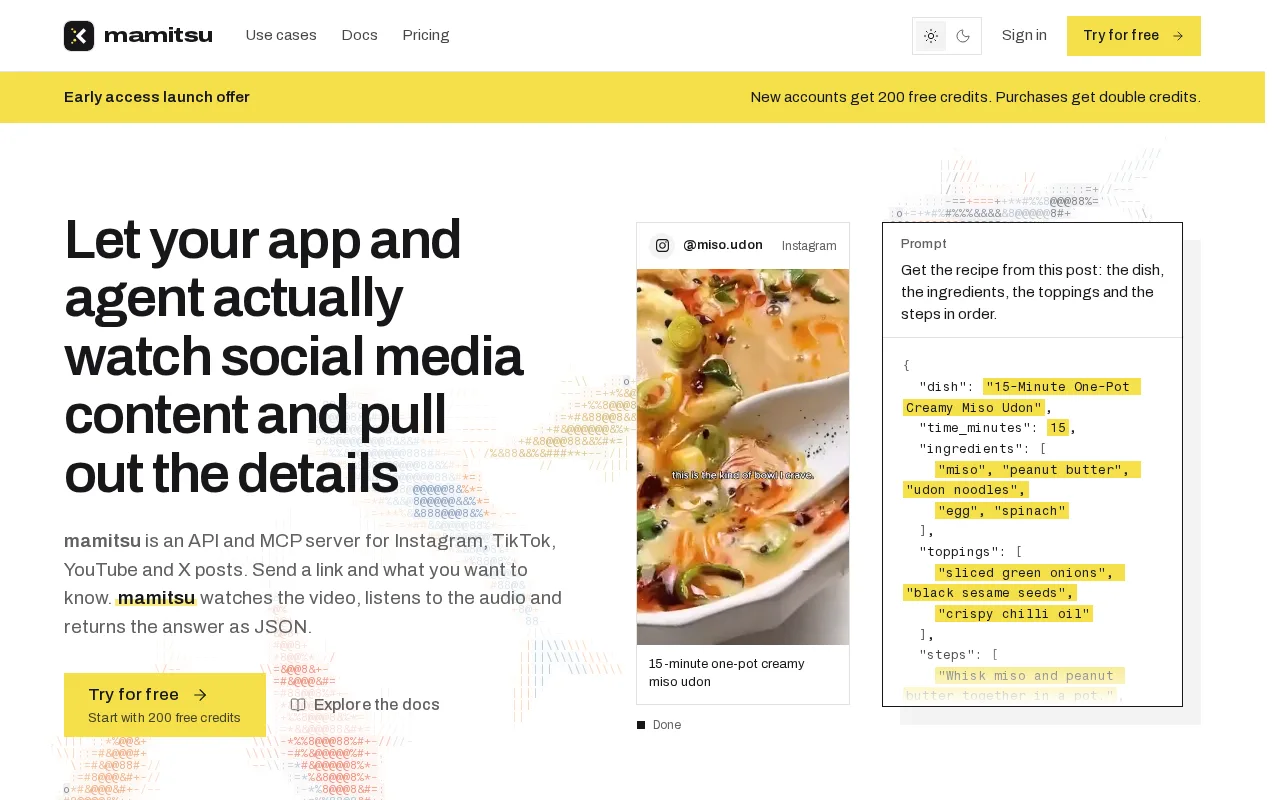
- 1Who it is for, in one line: apps and agents.
- 2The question is plain words. A JSON Schema is optional.
- 3ValueThe recipe comes back as fields an app can use.
On the map
The Skills Map is how I break product engineering down: twelve territories, like Discovery or Operations, and inside each the skills a person uses there, like pricing, alerting or SEO. Skills as in what you know how to do, not agent skills. The conversation reached ten territories and 38 skills. Each icon takes you to its section. The quick tour goes through the 38 skills one at a time, with what each meant for Mamitsu.
Where the conversation went
10 of 12 territories · 38 skills
Experience and Cross-cutting only came up in the wider discussion. Activation and Retention did not come up, apart from one idea about what brings users back.
Discovery: from a coffee recipe app to video data
Mamitsu is a side project that came out of another side project: a coffee recipe app. Unai brews each new coffee bag from a base recipe and adjusts it day by day: a bit finer, a bit more water. He built a recipe player that guides you step by step and tells you what to change tomorrow. Then it got out of hand: he normalised grinders, so a recipe for one grinder translates to yours. One of his goes by numbers, another by clicks. “It looks easy. It is a mess.” The app could also import recipes from Instagram reels and YouTube Shorts. It was a simple version: short videos only, and not much traffic at once.
That import is what the beta testers wanted. One friend wanted it for family recipes, another for his own coffee app, a third for a travel app. What they had in common was not coffee. It was useful information locked inside videos.
There is something here. It is in videos, it is not even text, but it can be structured. There is valuable information there that nobody is using.
I asked who else does this. Unai named Supadata and PostReef, with Apify as the generic version; Mamitsu also has comparison pages against TwelveLabs and ScrapeCreators.
Strategy: restraint and a cheaper bet
Unai gave himself two weeks to package it. He wanted to learn how to turn something like this into a product he would feel confident selling: one that works, holds load and is easy to use from an app or an agent. The products he admires, he says, share one thing: restraint.
Not being able to work on everything used to calibrate us. It forced us to prioritise. We do not have that any more.
So I asked what he had left out.
What Mamitsu does, and what Unai chose not to build
- Posts from Instagram, TikTok, YouTube and X
- A link and a question in, JSON out
- REST API and MCP serverFor apps and for agents
- Features built on YouTube transcriptsRaw video gives the model more
- Recipes sent to an app's Instagram accountPossible, but nobody had shown they would pay
- A scraper for any URL, not only social postsSome day, maybe
The cut that says most is transcripts. His bet is that the rawer the content, the easier it is to pull out whatever you need. The quantity in a recipe may only appear on screen; the name of a place may only be said out loud. So the model gets the video, not a transcript. And that has become very cheap.
The other bet is price. Supadata has traction, so: “People use this. Can I do it as well or better, and much cheaper?” He sent me the comparison page while we talked.
One extraction on Mamitsu and on Supadata
| Mamitsu | Supadata | |
|---|---|---|
| 45-second Instagram reel | US$0.005Best | US$0.028 |
| 10-minute YouTube video | US$0.030Best | US$0.283 |
| Credits | Prepaid, kept until usedBest | Monthly, do not roll over |
| Answer in the same requestSupadata returns a job to poll | YesBest | No |
| Facebook videos and media files | No | YesBest |
| Web scraping and crawling | No | YesBest |
Mamitsu is several times cheaper and simpler to call for social posts, and narrower. Its prices include the early-access offer of two credits per cent; new accounts start with 200 free credits.
Observedusemamitsu.com/compare/mamitsu-vs-supadata, read 14 Nov 2026. Supadata figures as Mamitsu read them on 11 Nov 2026; I did not check them on Supadata's site.
Supadata’s traction shows that people pay for this job. Whether they pay Mamitsu is what the relaunch will tell. Who pays? From what Unai read, marketing teams use Supadata to check that sponsored videos really mention their brand, and mention it well. That is the niche he is writing posts for. I suggested another: trend analysis. Finding what is trending on TikTok and Instagram is one problem; working out why it works is the one Mamitsu can solve.
Engineering: load-tested at 3,000 requests a minute
Selling with confidence meant holding load. The platforms he downloads from used to block him after about five requests in half a minute. Now, in his own load tests, Mamitsu takes 3,000 TikTok requests a minute without being blocked; in his words, they do not care. That is load he simulates, not traffic he has. The first version only read YouTube and Instagram; TikTok came with the product, and the day before our call an email to users announced X support and a playground inside the app.
Scraping social platforms, before and now
- 5
- Requests before a block
- About five, in half a minute
- 3,000
- TikTok requests a minute
- In his load tests, without blocks
- Daily
- Load tests
- His own biggest customer
He load-tests every day: the person spending the most money on Mamitsu is him. The 3,000 is load he simulates, not real traffic.
ReportedUnai Esteibar, on the call
How he got there did not come up, and I did not ask.
AI: a model that watches, agents that build
Where is the value? For Unai, in two things: getting the content, the videos and images, reliably and fast, and analysing it without your agent spending a fortune in tokens. The model call sits on top: frames, audio and caption in, JSON in the shape you asked for out, in the same request. Through the MCP server, an agent gets back only the fields it asked for, “so a ten-minute video costs a few lines of context instead of a full transcript”, as the site puts it. The agent plugins are on GitHub.
How does he know the answers are good? He does not measure it yet. Evals cost money, and at this volume he can read extractions himself. When he does start, comparing with a larger model shows where two models disagree, not which one is right. I would also check a sample against the video itself.
The team behind the product is agents. Unai runs Hermes on a Linux box at home, with nine or ten profiles split by project so one context does not leak into another. He talks to all of them in Slack. He dislikes sessions that start from zero; with an agent that remembers, a Slack thread works like talking to one more colleague. For code, Hermes launches Pi agents with a leaner setup, because he wants code written more predictably. He does not review every change. Which ones he reviews is decided per change, by risk.
Shipping: a risk score decides who approves
Moving tickets in Linear feels unnatural to Unai, so the pipeline lives in Slack. It starts with a conversation with Hermes about the feature and, roughly, the technical solution. He cares most about database migrations and how to roll back: that keeps the blast radius small. Then the agents take over. Hermes hands the work to Pi agents, gets back code and proof that it works, and opens the PR. It is the same Hermes, in the same session, from the first conversation to the PR; the Pi agents only talk to Hermes. The PR then goes to a referee agent, which Unai named Árbitro, Spanish for referee.
From a Slack conversation to production
One Hermes session runs the whole way, and only Hermes talks to the Pi agents. The referee checks that everything is green and easy to roll back, then gives one of three answers: back to Hermes, merge, or wait for Unai. Each PR carries its own rollout and rollback plan.
After a merge, the agent turns on a feature flag if needed, watches the logs until about ten requests have gone through the new code, and rolls back if something breaks. That has happened once. Otherwise he gets a Slack message saying all is well. The risk scoring is his own skill. Two years ago, a product with these processes would have needed a team.
Operations: errors fixed before he reads them
This is the part Unai finds most interesting: products that were not viable before because the maintenance they needed was not worth it. Agents change that.
A production error, from alert to fix
- 01An agent polls Sentry all the time.
- 03A Slack thread: is it a real error, does it need you?
- 06Once, this was the first Unai heard of the error.
There was one I only found out about when it was already fixed in production. Well, how nice.
Support works the same way. He forwards support emails that need attention to an internal address, it becomes a Slack thread, and an agent investigates. He steps in only when he has to.
Distribution: getting cited by AI answers
The launch was quiet. Traction? “A tiny bit.” New users trickle in and the product improved a lot in the week after launch. Next is a wider relaunch, Hacker News included.
The channel he works on most is GEO, generative engine optimisation: being cited by AI answers. “Build it and they will come” was never true, he says, but the coming part has changed. The day before our call he needed somewhere to centralise his agents’ MCP servers. He asked his agent to find and compare alternatives, and decided there, without opening a single landing page until after. “I had a decision right there, because I had everything I needed to make it.”
When you ask ChatGPT something, it runs your search plus many variations, opens what looks relevant and answers with citations. A citation means “this is where I read it”, not “I recommend this”. And unlike Google, nobody shows you what people ask. So you simulate it.
Unai's GEO loop
- 1Ask like a userPrompts from keywords, competitors and funnel stages
- 2Read the citationsWhich sources, and what they say about you
- 3Find the gapsQuestions where you do not appear
- 4Fix the contentAn agent drafts, Unai approves
Answers change every day, so the loop runs every day. What it cannot tell him is whether anyone clicked.
There are two ways into an answer. One is to be on the pages that already get cited, and to make sure they agree with you. His example was a jiu-jitsu dojo: a directory that AI answers cite listed it with different information from the dojo’s own website, and that makes it less credible. Search engines do not care; AI answers do, because the model cannot tell which version to believe. The other way is to get cited yourself, with guides, comparison pages and docs. An agent drafts them from the gaps, and he reads everything before it goes out: “I don’t like publishing things that have not been through me.”
He tracks all this in Omnia, a tool that monitors AI answers, and showed me Mamitsu’s numbers there. The method does not depend on the tool.
What Unai knows about Mamitsu in AI answers, and how
- Mamitsu appears in more answers since he started tracking themHis dashboard, shown on the call
- At first, models said they had no record of Mamitsu
- It does well when the question is specific, like a TikTok recipe to JSON, and worse for "extract information from a video"
- Some of his new users come from AI answersLinks in answers carry no tracking, and people may search for it elsewhere
- Many agents asking the same question could move the answersMy question. Nobody knows: the models are a black box
Being cited can be measured every day. Whether citations bring users cannot yet.
Being cited, being visited and being used are three different results, and only the first is measured. The cheapest way to start on the other two is a question at sign-up: where did you hear about Mamitsu?
Measurement: what he does not track yet
The website has web analytics: Rybbit, self-hosted. Inside the product he tracks nothing yet. Does he look at what people ask Mamitsu? Now and then, by hand. Feedback comes through the support email.
At the end I asked what he would take from the call. An agent that reads the week’s extractions and reports every Monday, cheap at the current traffic. It could run the first evals too: compare answers with a larger model, and spot uses he had not planned for. I added a question for that report: which extractions bring users back. He set it up straight away: the first report came in on Monday 16 November, three days after the call.
The weekly review Unai set up after the call
an agent reads last week's extractions every Monday and checks a sample against a larger model
Unai learns which answers are wrong and which uses he did not plan for, without reading them all
today he reads them by hand, and that stops working as soon as usage grows.
- Decided by
- Problems and new use cases each report shows him that he did not already know
- Stop if
- Two reports in a row with nothing new
Beyond the product
Half the call was about product engineering in general. What stayed with me:
Code is solved, if you pay. Product is not.
“If you are willing to pay for it, it is solved.” Only the economics are still settling. Product is another story. The skill that matters more now, for Unai, was always there: knowing what is important, simplifying, choosing how to attack a problem. And one field has no answers yet: experiences augmented with AI. The labs change the format of their products every few days. It will settle, the way all dashboards ended up looking alike, but not yet.
Demos instead of explanations
Unai used to struggle to explain his ideas. Now he often builds a two-hour demo and sends that. Many ideas are built in a morning and binned by the afternoon.
Take the product to where people already are
It will be harder and harder to bring people to new places, he thinks, so products will go where people already are: WhatsApp, Telegram, the assistant they already talk to. His example is AliExpress parcel tracking on WhatsApp. Nobody wants the app; a message about your parcel works. I live this with Etengabe, my Basque-learning app: with a free minute, I open Twitter, not a learning app.
Software for agents, and the risk of being sherlocked
I am starting to think about building for agents rather than for people; I no longer open my calendar, I send a voice message. Mamitsu is in that market, a service other agents call. The risk Unai sees: a product built on the labs’ models, or for their agents, gets copied when a lab ships it as a feature.
Code still matters where trust matters
Unai suggested agents could use Codiluce, my tool to see how code fits together, to review PRs. That is already solved; Codiluce is for the person who wants to understand what the agents did. We both admitted we have mostly stopped reading the code of our own projects. His point: in sensitive areas like security it still matters, because you have to be able to trust it.
What I take from it
- GEO is work you can do in the background. I treated appearing in AI answers as luck. Unai treats it like SEO: questions asked every day, citations read, gaps filled with content an agent drafts and he approves. I want to know what ChatGPT and Claude answer when someone asks how to become a product engineer, and whether this site is in the answer. Unai pointed me to Omnia’s write-up on PrintStash, a 3D-printing file manager, which runs the same loop on a new product.
- Restraint, also in how many products I build. Unai’s point was about features: when building is cheap, nothing forces you to prioritise. It works one level up too. I have several side projects, and agents make it easy to start another one. The cut list should have products on it as well.
- Automate the loops around the product. Errors, support emails and content drafts reach Unai’s agents before they reach him. Those are the jobs that make a side project too expensive to keep running. I want the same for mine: alerts that arrive with a diagnosis, feedback that becomes a weekly report, content drafted from the gaps.
Connected work
4- 18 Nov 2026RelievApp, Part I: is it a meditation app?