RelievApp, Part I: is it a meditation app?
RelievApp is a web app of two-minute, hands-on sessions that help you move from a hard feeling to a more manageable one. Part I of building it with agents covers five promises in five weeks, a broad catalog held together by a playful design system and a mascot, and a session you can give to someone you love.


- Question
- How do you position, design and distribute a new kind of wellbeing product when you are not sure yet which category it belongs to, and what changes when agents build every version?
- How I looked
- My own product, so this is a maker writing about his own decisions, not an interview. Sources are the git history of the code (June to 18 Nov 2026), my decision log, the transcripts of eleven coding-agent sessions (Claude Code, 20 Oct to 18 Nov), the agents' audit and second review, an outside strategy review I asked ChatGPT for, and my spoken feedback on the Ten Shifts prototypes. Retired versions were rendered from their commits; the current one was captured on staging at phone size on 18 Nov 2026. There are no usage numbers yet. Production (reliev.app) still runs the 14 Oct version, so every score here is a judgment, mine or an agent's, and says so.
- Product
- RelievApp by Mikel Torres Ugarte. A web app of two-minute, hands-on sessions that help you move from a hard feeling, such as anxiety, anger or overthinking, to a more manageable one, with your eyes open and one hand.
- Interviewed
- Mikel Torres Ugarte, Maker of RelievApp
Who and what
RelievApp is a web app of two-minute, hands-on sessions that help you move from a hard feeling to a more manageable one. You feel anxious, angry, overthinking or low. You say how strong it is, you play a short session with one hand and your eyes open, and you say how you feel after. It runs in the browser on a phone or a computer, in English and Spanish, with nothing to install.
It is my own product. I started it because meditation helps me, but I find it hard to stay with. A picture, and something to do with my hands, work better for me. I build it with coding agents, and in five weeks it made five different promises.
This is Part I: from the launch on 14 October to 18 November 2026. There are no usage numbers in it yet. As I write, reliev.app still runs the October version, and everything new is on a staging server. Part II comes with traffic and numbers.
The front door on 18 November: a promise, one button, a deck of sessions
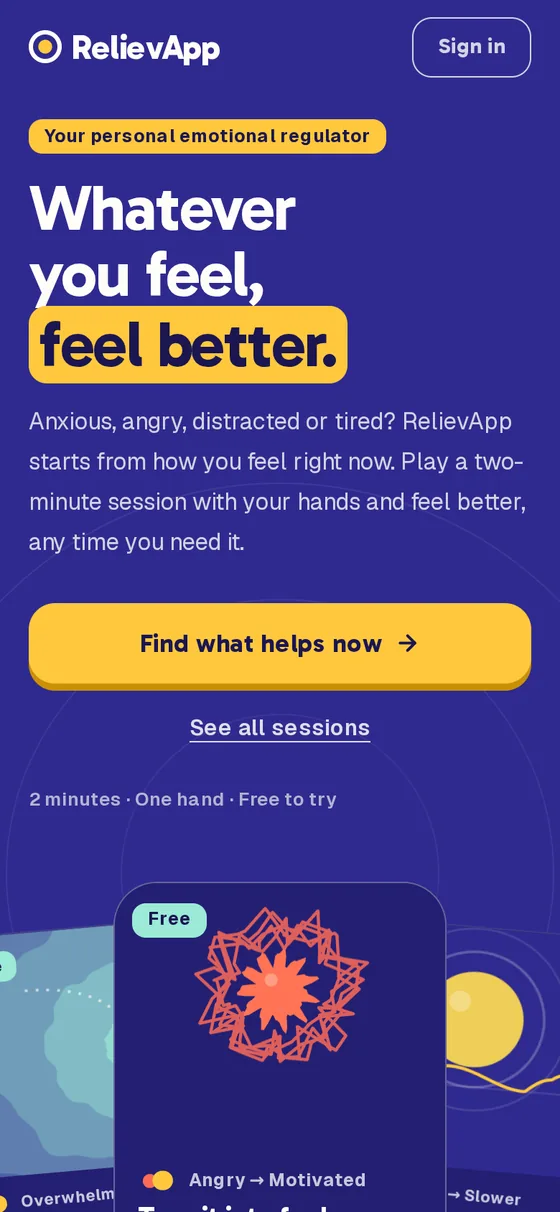
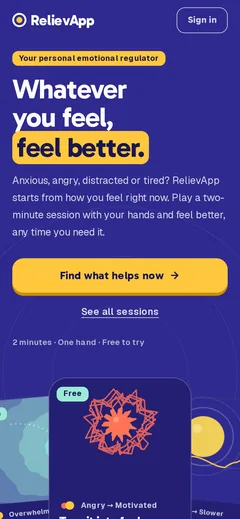
- 1The category it claims now: a personal emotional regulator.
- 2ValueOne button. A map of feelings picks the session for you.
- 3Live session cards, each one playing its own before and after.
On the map
Part I reached seven territories of the Skills Map and 24 skills. Each icon takes you to its section; the quick tour goes through the skills one by one.
Where Part I went
7 of 12 territories · 24 skills
Activation, Retention, Engineering, Shipping and Operations wait for Part II, when real people use it.
Discovery: who else helps people feel better
Under every version there was one question: is this a meditation app? The answer depends on who you compare it with. I looked at what people already use when they feel bad, and I gave ChatGPT the prototype for an outside view: how to categorize it, whether people would pay, how to distribute it.
It came back with four categories: meditation and mindfulness, stress relief and breathwork, interactive digital wellness, and digital therapeutics. Reliev fits the first two. It would be most different in the third. It is not the fourth, which needs clinical evidence and medical-device rules. One line from that review stayed with me: “Calm teaches meditation. Breathwrk guides breathing. TRIPP creates immersive environments. Reliev could make emotional regulation a short, tangible, interactive action.”
Where RelievApp sits among the products people use to feel better
- 1CalmAudio meditation, sleep stories, a huge library
- 2HeadspaceGuided meditation with drawn characters
- 3TRIPPImmersive scenes in VR and on the phone
- 4FinchA pet that grows with your self-care
- 5BreathwrkBreathing exercises; Peloton bought it in 2025
- 6RootdHelp in a panic attack
- 7LumenateLight patterns, with your eyes closed
- 8RelievAppTwo-minute sessions you do with your hands
The top right was empty. That is a reason to be there, and also a warning: maybe nobody looks for it.
AssumedPlaced by my judgment from each product's site and store page, Nov 2026
The closest products are not the biggest ones: Breathwrk for short breathing exercises, Lumenate for light you watch with your eyes closed, Finch for a pet that brings you back. And for someone anxious right now, the real alternative is not an app at all: a breathing video, a walk, the feed.
The jobs said the same. An agent’s audit listed seven. The strongest was not “calm me down” but “a way in that isn’t meditation”: I know breathing helps, but I can’t sit with it. That was my own story, and the product only said it in a FAQ.
Strategy: five promises in five weeks
Every version answered the category question in a different way.
Five promises in five weeks
- 14 OctLaunch: "Transition from anxious to calm."ShippedOne glowing sphere you change with your hands. Its own category, "transitions". Production still runs it.
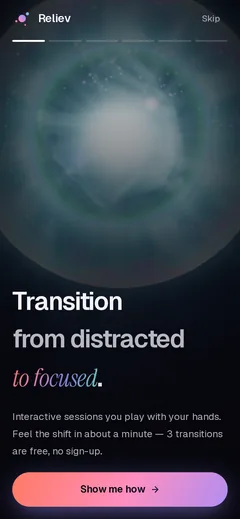
- 20 OctThree worlds: a sphere, a brain, a bodyShipped14 moods and 18 transitions, on staging.

- 15 NovA front door per channelDecisionA stress toy for TikTok, a nervous-system reset for Reels, the old page as the control. One app behind all of them.

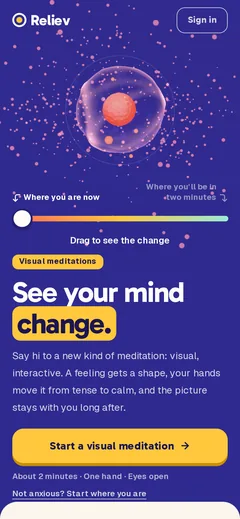
- 15 NovVisual meditationsShipped"Meditate with your eyes open", then "See your mind change". Headspace was the reference.

- 16 NovAudit: 5 out of 10ProblemFour promises at once, and 40 to 60 seconds before the first calming gesture.
- 16 NovOne door: a meditation app with superpowersDecisionEight moods, twelve sessions, the brain out. Second review: 7 out of 10.
- 18 NovTen Shifts: ten prototypes, from zeroInteractive emotional regulation, "without considering what we've already done".

- 18 NovYour personal emotional regulatorDecisionA broad catalog of 21 sessions, a design system and a mascot. On staging.
- 18 NovGive a sessionShippedA free session as a link, for someone you love. Reliev becomes RelievApp.

At launch, Reliev had its own category: transitions. It set the product apart, but nobody searches for a transition. On 15 November I wanted to grow through TikTok and Reels, and instead of choosing a promise, the agents built several front doors on the same app. On 16 November an agent’s audit said that was the problem: four promises, and slow to help. It recommended “in-the-moment anxiety relief”, a small shelf next to Rootd and DARE. I chose “a meditation app with superpowers” instead, and accepted the comparison with Calm and Headspace.
Two days later I asked an agent for ten prototypes of interactive emotional regulation, built without looking at what we had: a pendulum, a worry jar, a map where you place your feeling, a scribble you calm down. Then the real question: a few consistent metaphors, or a broad catalog where almost anything fits? I chose broad, and let usage decide.
We'll be able to establish and define certain metrics, see which sessions perform better, which ones users repeat most often, which ones they like best, and use that information to develop a product ideation strategy. In other words, the product itself will ultimately help us discover what it should become.
So the promise moved from the picture to the place: your personal emotional regulator. “Whatever you feel, feel better.” Is it a meditation app? The front door now answers that itself: “Partly, in a new form: slow breathing, focused attention, letting go. Some sessions are more like a game.”
Sessions in the catalog, version by version
- Launch, 14 Oct3 free12 sessions
- Three worlds, 20 Oct5 free18 sessions
- Visual meditations, 15 Nov5 free17 sessions
- One door, 16 Nov4 free12 sessions
- Emotional regulator, 18 Nov10 free21 sessions
The catalog grew, was cut by a third, then grew past where it started.
ObservedEach version's pages, rendered from its commit; the regulator on staging, 18 Nov 2026
Going broad has a price, and I want it written down. A catalog is harder to say in one line: “personal emotional regulator”, like “transitions”, is a phrase nobody searches for. It gives more choice to someone who is struggling, which is what the cut of 16 November tried to avoid. And with little traffic, 21 sessions split the sample 21 ways, so it takes longer to tell a good session from a lucky one. The catalog is a research tool as much as a product, and it may get narrow again.
What going broad moved, from 16 to 18 November
- One picture people learnMany kinds of session
- Easy to say in one lineRoom to find what works
- Few choices when you struggleA session for every feelingThe router suggests three
- Measure one first sessionMeasure many at onceLess traffic per session
The positions are my judgment. The design system and the router are there to pull the first and third rows back a little.
Assumed
The answer to too much choice is on the first button. “Find what helps now” opens a map of feelings: you drag a light to where you are, name it with a word, and it suggests three sessions.
Find what helps now: place yourself, name it, get three sessions
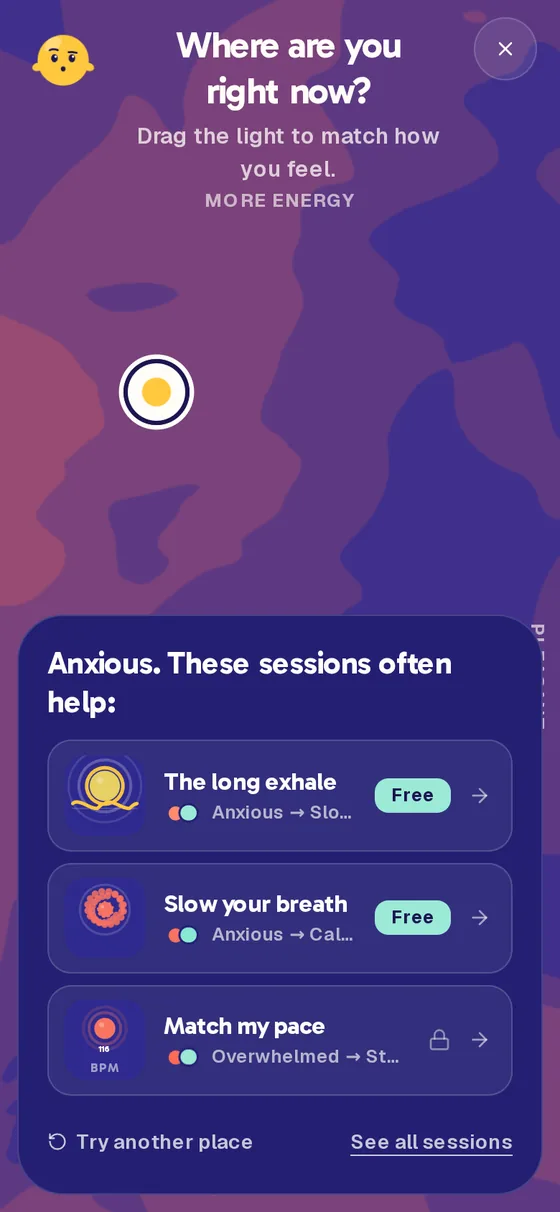
- 1ValueThree sessions for the word you picked, free ones first.
Experience: playful on purpose
The launch looked like a screensaver: dark, with a purple glass sphere in a nebula. Beautiful, and serious. The new front door is flat colour and round shapes on an iris blue ground, with yellow buttons and a mascot.
The front door at launch and on 18 November
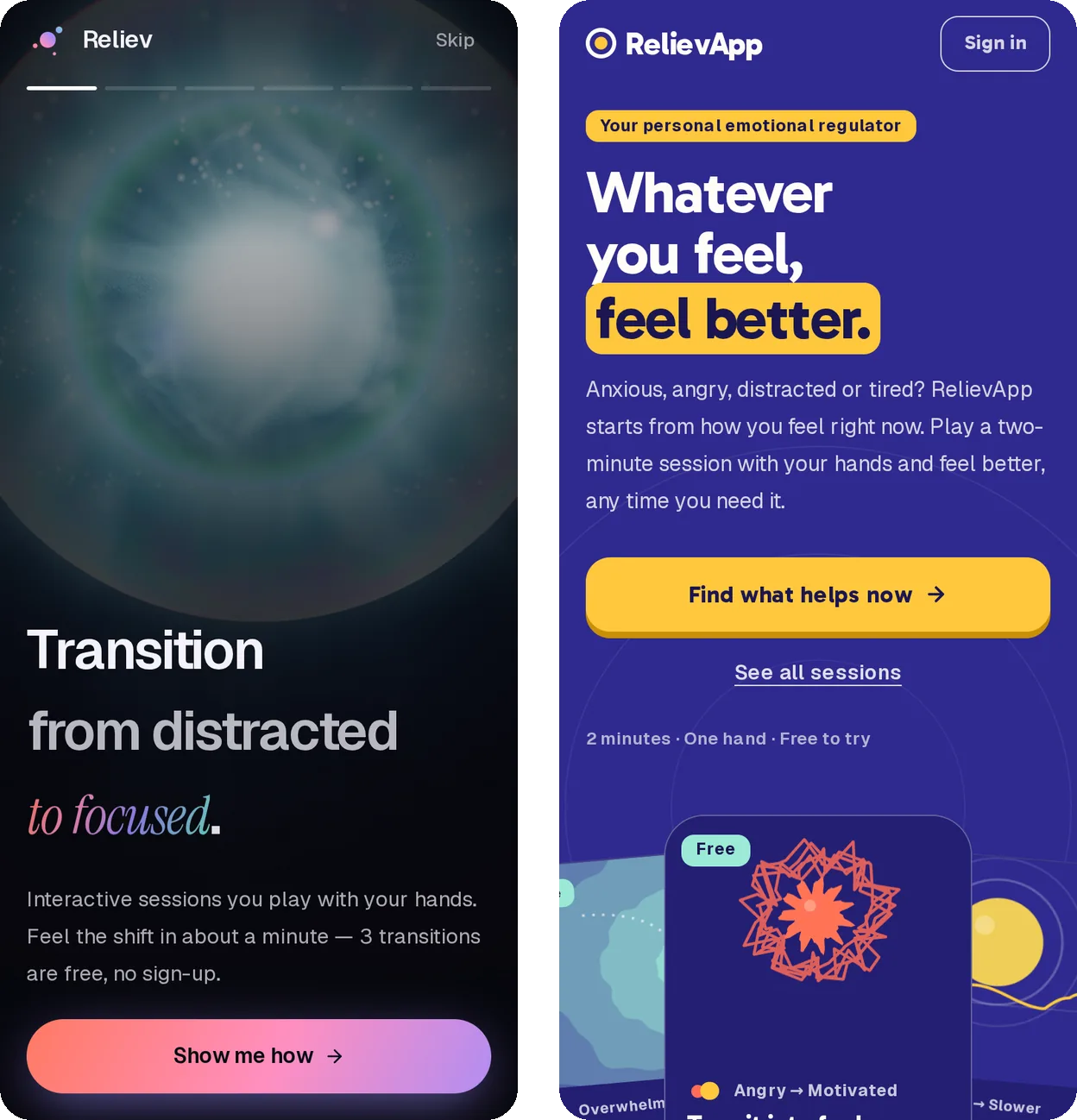
- 114 Oct: dark, a glass sphere, a category of its own.
- 218 Nov: flat colour, round shapes, a deck of sessions.
The playful look is a decision, for three reasons. The first is sharing: if distribution has to live inside the product, people must be happy to show it. A brand that is warm and a little funny is easier to send to a friend than a dark, clinical one. Headspace showed that with its drawn characters, and it was my reference from the meditate door on. The second is a mascot: a playful system can carry a character. The third is range. A broad catalog needs a system loose enough for a breathing ring, a shooting star and a fire, and strict enough that all of them look like one product.
Lev, the mascot: it feels what you feel, then shows you the way back
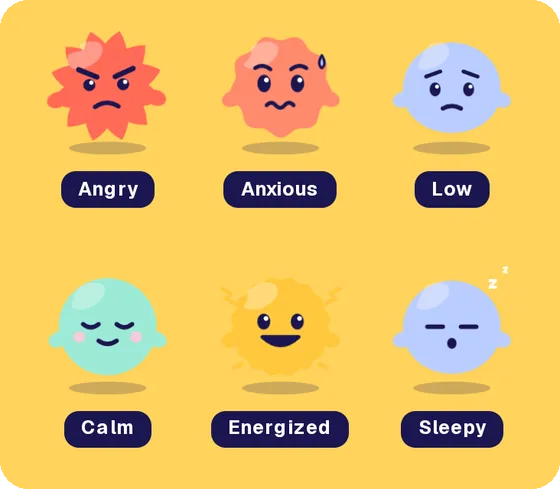
Lev is the sun dot from the logo, come alive. It shows how you feel, at the check-in and on the front door, and never decorates a session.
The rules are written down for people and for agents. Ten colours and no others, each with a meaning: coral is the hard end, sun is energy that works for you, mint is settled. One gesture per phase: first show where you are, then change it. Nothing can be failed, and the change shows early. The words have rules too: no engine words like “particles” or “nucleus”, checked by a script. And the English is written for people who learned it as a second language, because many of the people it is for did.
Distribution: a session you can give
On 16 November the second review moved most scores up. Distribution readiness stayed at the bottom. The product was better, and nobody new would see it.
The agent's two reviews of 16 November
| Audit, morning | Second pass, afternoon | |
|---|---|---|
| Positioning and category | 5/10 | 7/10 |
| Landing page | 7/10 | 8/10 |
| Onboarding into the first session | 4/10 | 8/10 |
| Inside a session | 5/10 | 7/10 |
| Distribution readinessProduction and the ads still showed the old product | 3/10 | 4/10 |
| Overall | 5/10 | 7/10 |
Nine changes in one day fixed the product's worst scores. Distribution barely moved, because nothing in it had changed.
AssumedAn agent's judgment on staging at phone size, without usage data
At launch the plan was paid ads: €50 a month, pointed at reliev.app. The ChatGPT review was blunt: at €49.50 a year, a product can’t pay app-store prices for each customer, so distribution has to be part of the product. “The link is the distribution unit.”
On 18 November I asked for that. Is someone you love struggling right now? Give them a session, free.
What the person who receives a session sees first
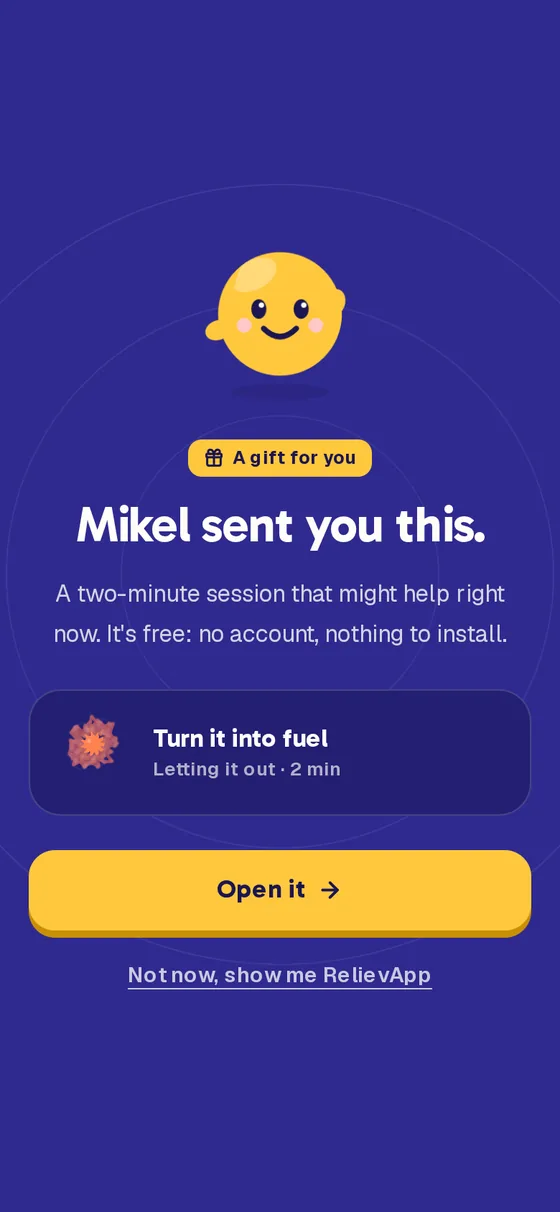
- 1The sender's name comes from the link.
- 2The link names the session, never a feeling.
- 3ValueIt opens free: no account, nothing to install.
You find it in two places: in a section of the front door, and at the end of a session that helped. You pick how the other person feels, sign it with your name if you like, and send it through the phone’s share menu, WhatsApp, Telegram, Messages or email, or post it on X, Facebook, Threads or LinkedIn. They see “Mikel sent you this.”, and the session plays free. Two details matter more than the buttons. Nobody receives a link that says “anxious”. And the gift replaced the “email me a link to come back” box: the moment after a session that helped is now spent on someone else.
The loop a gift could start
- 1A session helps
- 2You give itYour name, a link, any app
- 3They open it freeNo account
- 4It helps them too
- 5They give one, or joinNot measured yet
The gift is also why the name changed the same day. Reliev became RelievApp, so someone who hears the name can type reliev.app. (I also asked an agent for other names. Its advice: keep RelievApp for now, and if I rename, use Lev, the mascot as the brand.) Next comes a landing page only for giving a session, to use in marketing.
Measurement: one arc, the same events
A broad catalog is only research if every session is measured the same way. All 21 run inside the same arc: say how strong the feeling is, do the session, rate it again, then keep it, go again or try another. Every one sends the same events.
Turn it into fuel, one of the nine new sessions, from check-in to the gift
- 4
- screens to first value
- 0
- decisions asked first
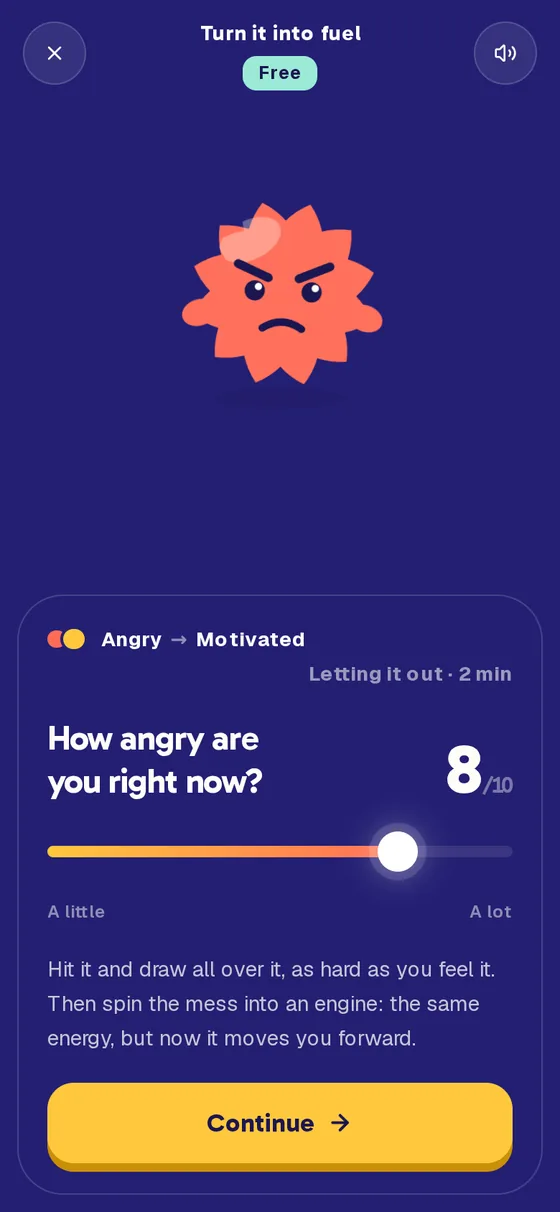 1
How angry are you?
One slider, the same in every session.
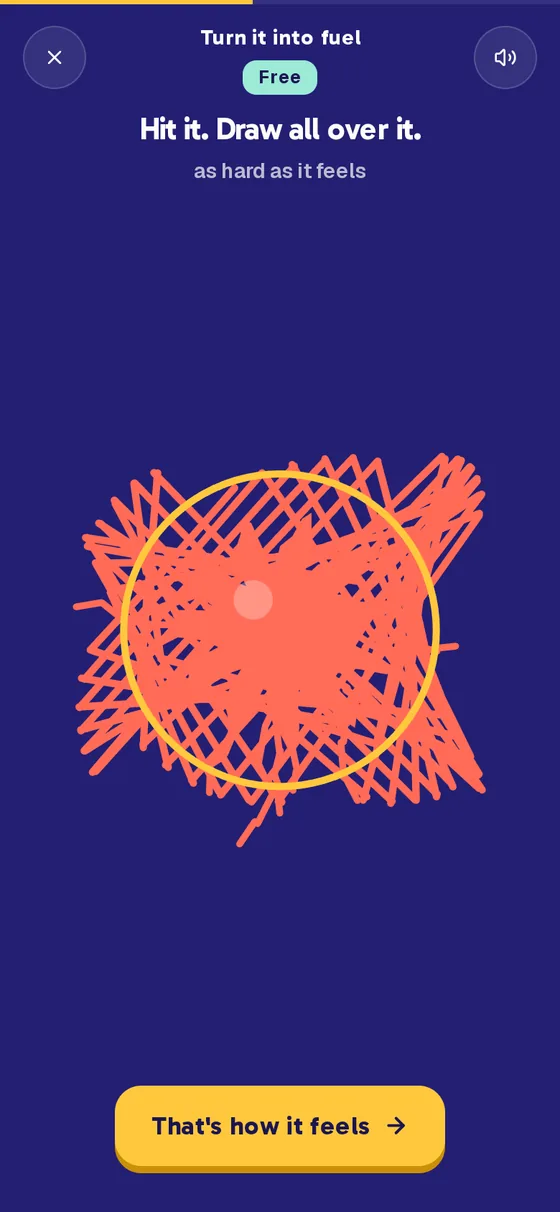 2
Hit it, draw all over it
First, show where you are.
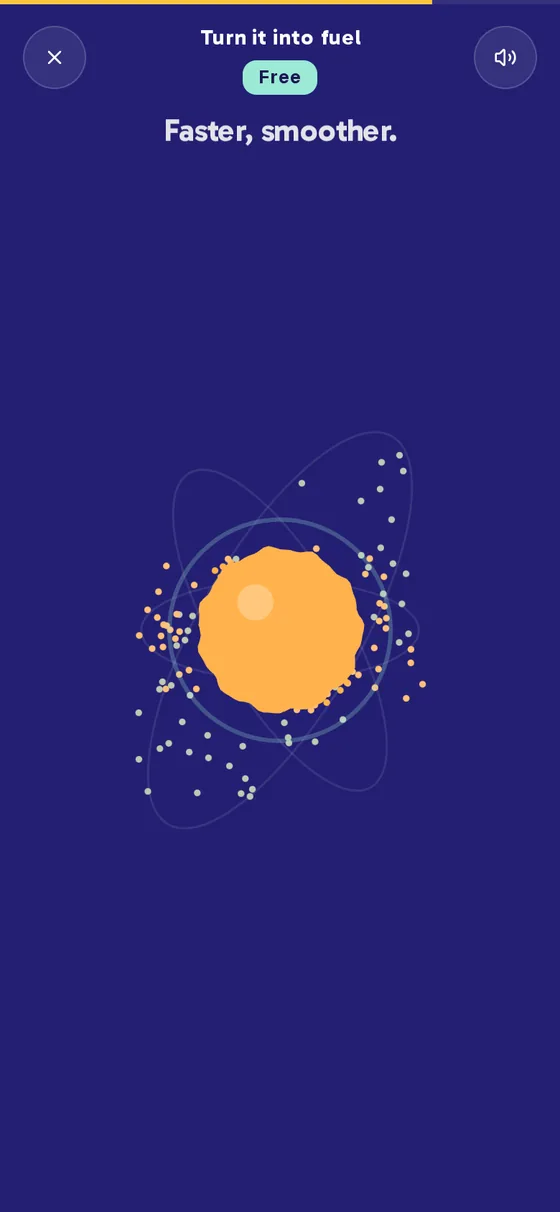 3
Now spin it
The same energy becomes an engine, not calm.
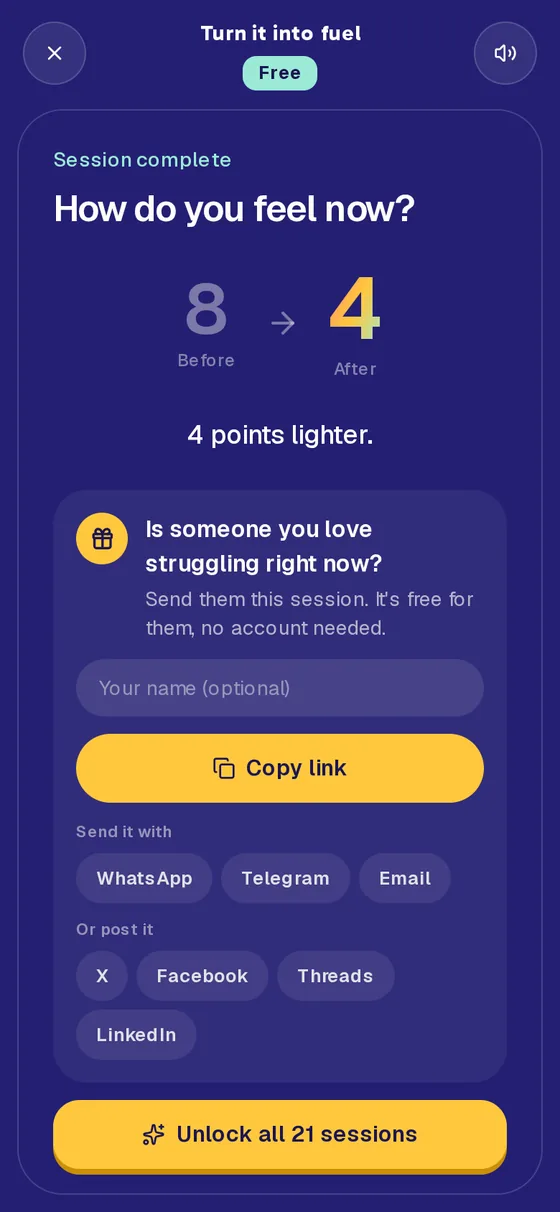 4First value
8 before, 4 after
The rating, then the gift card.
That session shows a change from my feedback: transform the energy instead of only reducing it. The rating is honest by design: no head start on the “after” score, and a rating you did not touch does not count. Still, it is how someone says they feel, not proof that it works. The numbers will say which sessions to keep, change or drop.
AI: a studio of agents
I did not write the code. At least eleven agent sessions built the versions, researched the channels, audited the product and turned my spoken feedback into sessions. On 18 November one agent took the prototypes I liked and rebuilt them as nine sessions in the house style, with Lev and a new front door: about 45 minutes from my message to staging. In the afternoon, three agents worked on the same code at the same time.
Three agents on one codebase, 18 November, afternoon
- 02Rewrite the copy in international English.
- 04Committed, and it told the copy agent too.
- 06Sent to both. Each agent committed only its own changes.
- 07Who may give a members-only session.
Agents also review: the audit, the second pass and ChatGPT each saw something I did not. But they do not decide. The audit said “anxiety relief”, I chose meditation, then I chose something else.
Beyond the product
When a version costs an hour, changing direction twice in a week is affordable. That changes how I decide. A decision that is cheap to undo can be made with less evidence, so I make it, ship it to staging and look. The risk is to confuse moving with learning. Five promises in five weeks, with no real users, are five opinions, most of them mine.
What I know after Part I, and what is still a bet
- reliev.app still runs the 14 October version; everything new is on staging.Both sites, 18 Nov 2026
- Nine sessions, Lev and a new front door took about 45 minutes from my message to staging.Session transcript and commit eb7293a
- Paid ads alone are a risky way to grow a product sold at €49.50 a year.ChatGPT strategy review, Nov 2026
- A playful brand with a mascot makes people more willing to share it.
- The sessions people finish, repeat and rate best show what the product should become.
- People will give a session to someone they love, and some of them will come back.
What I take from it
- A category is a bet on who you will be compared with. “Meditation” meant a comparison with Calm and Headspace. “Personal emotional regulator” brings nobody yet, which is good for being different and bad for being found.
- Put distribution where the product just worked. Papermark grows through the links its customers send. If RelievApp grows, it will be through the sessions people give, right after one helped them.
- Breadth needs stricter rules, not looser ones. The design system is what makes 21 sessions one product.
- Next, in Part II: production gets the new version, traffic arrives, and the numbers say which sessions stay.
What Part II has to answer
All traffic goes to the broad catalog, with the same check-in, rating and events in every session
A few sessions will clearly lead on finishes, repeats and the change people report
People in different states need different things, and a broad catalog lets them show us which
- Decided by
- Repeat use within 14 days, per session
- Keep if
- Three to five sessions lead, with enough people in each to tell them apart
- Stop if
- Nothing stands out after a month: narrow to the best few and test again