Market category
Choosing the category that makes the product's value obvious.
The category a product claims decides what people compare it with and what they expect. A well-chosen category makes strengths obvious, and a poor one makes them invisible. Sometimes the right move is a sub-category of an existing market rather than a new one.
Why it matters for a product engineer
The category you claim decides what people compare you with, which features they expect, and what they search for. Engineers feel it directly: a category brings a list of features buyers take for granted. Choose a category where your strengths are visible, and know which basics it makes mandatory.
How to do it
- List the categories a buyer could put the product in, starting from what they use today.
- For each one, write what buyers expect and who they would compare you with.
- Choose the category where your strengths matter most and your gaps matter least. Often that is a sub-category of an existing market, such as “open-source data rooms”.
- Check that people search for it and understand the name.
- Match the product to it: the basics the category demands, and the words on your pages.
- Move to another category when the buyers change, and change every page at once.
Common mistakes
- Inventing a new category nobody searches for.
- Claiming a category whose basic features you lack.
- A category that puts you next to a much bigger, better-known product.
- Different categories on different pages.
Example
Papermark started as “the open-source DocSend alternative” and, as its buyers changed, became “secure data rooms for dealmakers”, with open source below the fold. RelievApp started in a category of its own, transitions, which nobody searched for. It then tried meditation, and on 18 November became “your personal emotional regulator”. (Papermark, RelievApp)




The categories RelievApp claimed in five weeks
- 14 OctLaunch: "Transition from anxious to calm."ShippedIts own category, "transitions". Nobody searches for one.

- 15 NovVisual meditationsShipped"Meditate with your eyes open". Headspace was the reference.

- 16 NovOne door: a meditation app with superpowersDecisionIt accepted the comparison with Calm and Headspace.

- 18 NovYour personal emotional regulatorDecisionA broad catalog of 21 sessions. On staging.
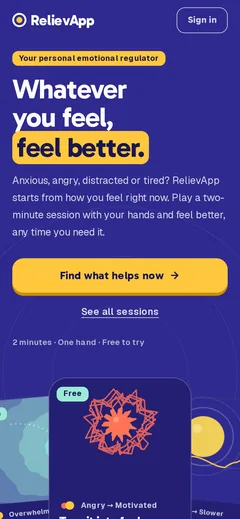
Each category brought a different comparison. A new category made the product unique and hard to find.
Sources: Product framing can help grow your startup, or kill it (April Dunford) ↗
In practice
Real products- 18 Nov 2026RelievApp, Part I: is it a meditation app?
Resources
2- articleStart here
How context can transform your product ↗
April Dunford · 2017 · 7 minA startup story where changing the frame around the same product changed its results.
- articleGo deeperApril Dunford · 2017 · 10 min
Four ways to frame a product against a market category, from leading one to redefining it.