Value proposition
The specific benefit a product promises to a specific user.
A value proposition says what users get, compared with what they use today, in terms they care about. It connects the problem to the product. If the team cannot state it in one or two sentences, users will not understand it either.
Why it matters for a product engineer
The value proposition is the sentence that connects the problem to the product. It decides the first screen, the onboarding and which features come first. If the team cannot say it in one or two sentences, users will not understand it either, and engineers will build features that pull in different directions.
How to do it
- Name the user and the situation, using your target audience.
- Write what they get, in their words, compared with what they use today.
- Add the proof: a number, a demo, a before and after.
- Test it where people decide: a landing page, an ad, the first message of a sales call.
- Check that the product keeps the promise in the first minutes. A promise the product does not keep loses people faster than a weak one.
- Change it when the product or the audience changes, and update every page that repeats it.
Common mistakes
- Describing features instead of the result for the user.
- Words like “all-in-one” or “seamless” that every product uses.
- A promise for everyone, which speaks to nobody.
- Several promises at once, on different pages.
- A promise the first minutes of the product do not keep.
Example
RelievApp launched with “Transition from anxious to calm”, in a category of its own that nobody searched for. In November it tried several promises on different front doors, and an audit found that was the problem. On 18 November the promise became a place to go: “Whatever you feel, feel better”, with one button that finds a session for how you feel. (RelievApp in In practice)


The front door on 18 November: a promise, one button, a deck of sessions
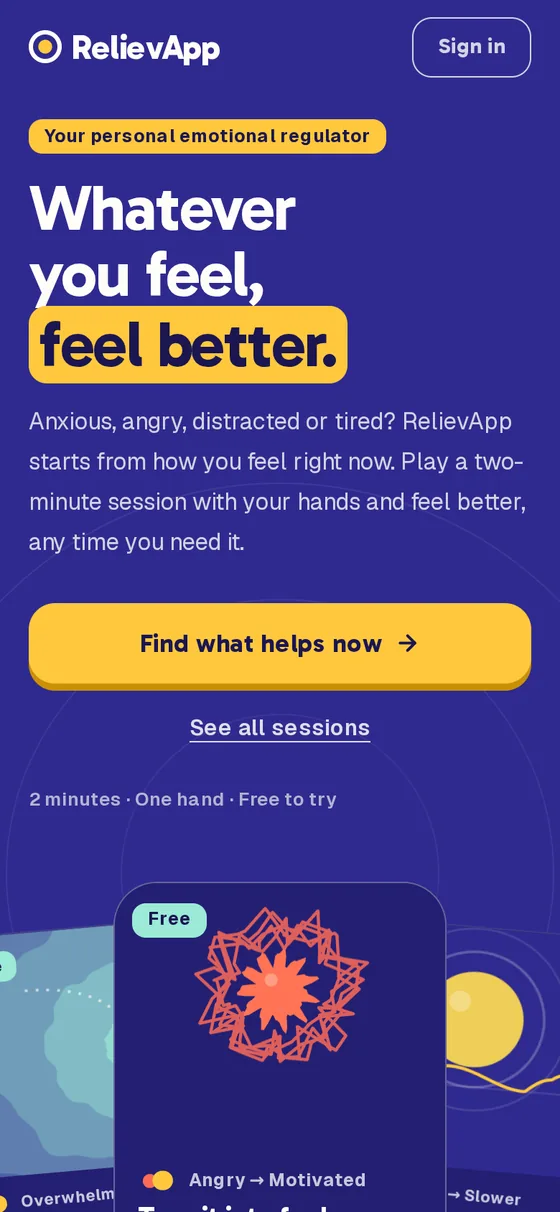
- 1The category it claims now: a personal emotional regulator.
- 2ValueOne button. A map of feelings picks the session for you.
- 3Live session cards, each one playing its own before and after.
The promise, the action and the proof on one screen.
In practice
Real products- 18 Nov 2026RelievApp, Part I: is it a meditation app?
Resources
1- articleStart here
An introduction to positioning ↗
April Dunford · 2020 · 5 minThe five parts of positioning, starting from the alternatives customers would use if you did not exist.